

What Is Gemini 4 Argon? Google's New Frontier Model Explained

2026-10-10
Gemini 4 Argon is Google's new frontier model with a 1M output token limit and strong benchmarks. Here's what it does, its pricing, and when Android users get it.
Google announced Gemini 4 Argon on September 30, 2026, and it's the first model in the Gemini 4 family. If you use Gemini on your phone, this is the release that will eventually reach you, once Google opens it up.
Argon is aimed at hard, long-running work: real software engineering, legal and finance research, and cybersecurity defense. That sounds far from a phone in your pocket, and for now it's. Here is what the model actually is, why it matters, and when normal users get a crack at it.
What Gemini 4 Argon Is and Who Gets It First
Gemini 4 Argon is Google's new frontier Google AI model, and it's rolling out first to a narrow group: trusted cyber defenders through the Fairwind Program, plus the U.S. government's pre-release review process.
Google is being deliberate here. The company trained Argon to be unusually strong at defensive cybersecurity, including finding, validating, and patching software vulnerabilities on its own. Handing that to everyone on day one would be reckless, so access is phased. Trusted defenders get it without cyber guardrails so they can use the full capability; everyone else waits.
For a regular Android user, the takeaway is simple. Gemini 4 Argon isn't in the Gemini app yet. It will reach developers, enterprises, and consumers "as soon as possible," which is Google's way of saying there's no firm date.
How Gemini 4 Argon's 1M Token Output Works
The headline engineering change is the output token limit, and it's dramatic: 1 million tokens, up from 64K.
Here's what a token limit actually means. When a model answers you, it generates tokens one after another. Older limits capped how much it could produce in one pass, which forced long tasks to be chopped into pieces. Argon can generate hundreds of thousands of tokens in a single continuous run, so it can hold a long reasoning chain without stopping to reset.
That matters for tasks like refactoring a large code module or drafting a lengthy legal analysis. The model keeps the whole thread in one go instead of losing the plot between chunks. For a chat app, you won't notice the ceiling. For heavy work, the ceiling was the problem, and Argon removes it.
Gemini 4 Argon Benchmarks Explained
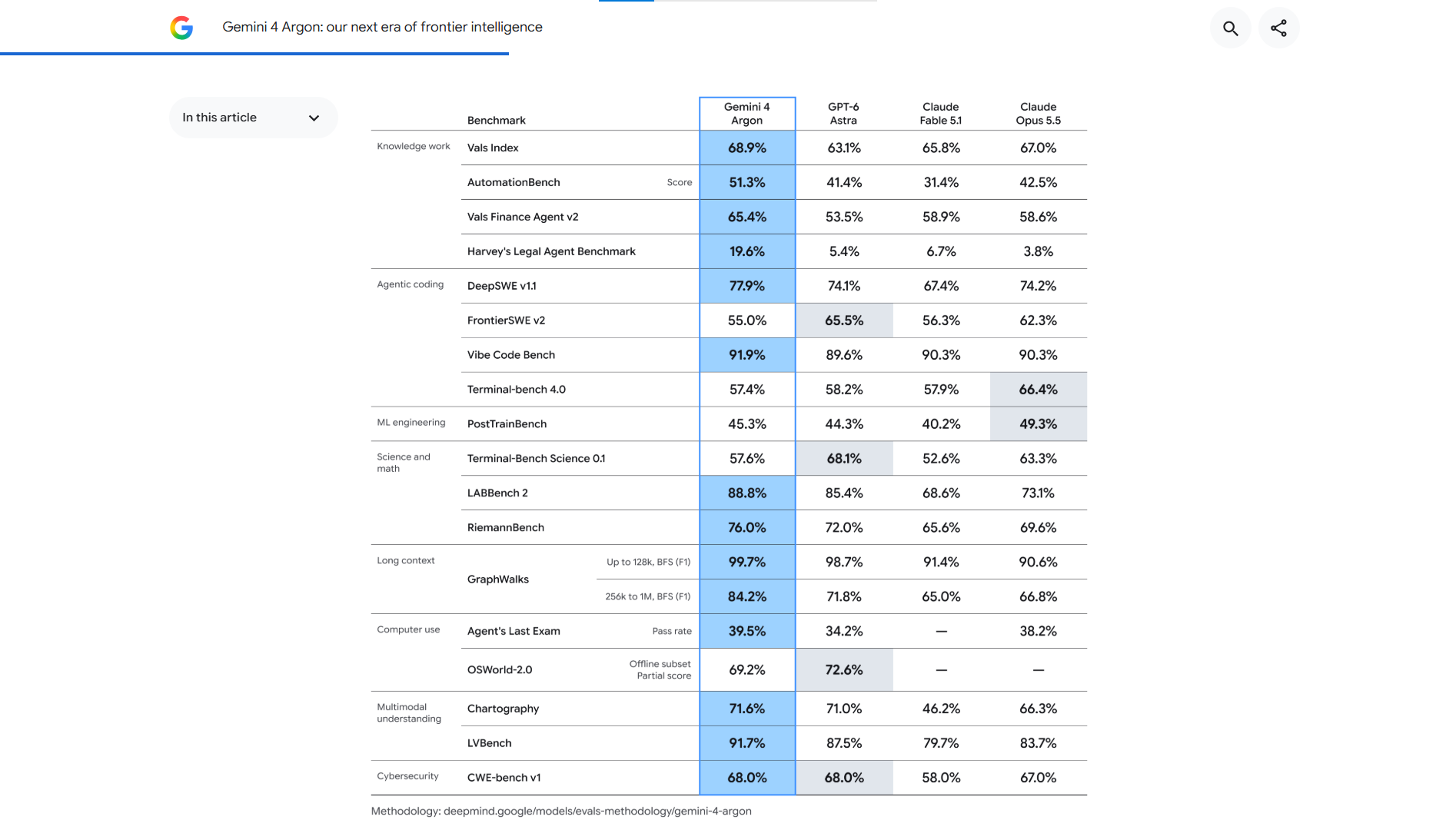
Argon's benchmark numbers are where Google makes its case, and they're strong.
- DeepSWE v1.1: 77.9%, a new state of the art for long-horizon software engineering.
- Vals Index: leading across finance, coding, legal, and tax work, weighted by contribution to U.S. GDP.
- LVBench: 91.7% on long video understanding, also state of the art.
- AutomationBench: 51.3%, ranking first on end-to-end business-function execution.
- Vals Finance Agent v2: 65.4%, a weighted score rather than a raw pass rate.
One caveat worth knowing: those finance scores use weighted partial credit with dealbreaker gates, so 65.4% doesn't mean 65.4% of tasks were fully correct. Benchmark numbers are directional, not gospel, and vendors choose the tests that flatter them.
Imgae Credit: Google
How Gemini 4 Argon Helps Real Work
Google published concrete internal results, which is more useful than a leaderboard.
- A quantum computing team used Argon to reduce qubit-and-gate resource use, beating a published baseline by 40% in minutes.
- Argon agents analyzed data-center telemetry and freed over 300 TiB of memory, with estimated total savings up to 1 PiB.
- Agents are migrating C and C++ codebases to Rust across Google, from small libraries up to the 800K-line Fuchsia Zircon kernel.
- On libgav1, a video decoder, agents replaced 32K lines of SIMD code and produced a memory-safe version that runs 2.7x faster.
The pattern is clear. Argon is built for agentic work, where the model runs for a long time, checks its own output, and iterates. That's a different use case than asking a chatbot to summarize an article, and it explains the 1M output limit.
How Gemini 4 Argon Compares to Its Rivals
Argon lands in a crowded field. Google frames it as closing a pricing triangle against competing frontier models, and the introductory rate undercuts several of them.
The more interesting comparison is on capability, not price. Argon's DeepSWE v1.1 score of 77.9% puts it at the front of long-horizon software engineering, the kind of task where a model works for a long stretch and fixes its own mistakes. Its LVBench score of 91.7% leads long video understanding, which matters for anyone who wants an assistant to watch a meeting recording and pull out the decisions.
Where Argon doesn't obviously dominate is raw conversational polish, and that's fine. Google positioned it for agentic and enterprise work first, so it competes on sustained output and domain benchmarks rather than chat vibes. If you're comparing models for a hobby project, the numbers matter less than whether the model you already have access to is good enough.
Gemini 4 Argon's Limits and Open Questions
Argon isn't available to the public, and Google's own messaging admits the guardrails are still being tuned. That's the biggest limitation for anyone outside the defense world.
The phased rollout also means early benchmark reports come from Google and a handful of testers, not from independent, broad usage. Independent evaluators like Artificial Analysis have weighed in, but the sample is small. Treat the launch numbers as a strong opening argument, not a settled verdict.
There's also the usual question of how much of a frontier model's advantage survives contact with your actual use case. A model that wins on a coding benchmark may feel no different in a phone chat unless you push it toward long, complex tasks. The 1M output limit is a real capability, but you need a job big enough to feel it.
Gemini 4 Argon Pricing and Availability
Argon launches at an introductory price of $2 per million input tokens and $10 per million output tokens, with cached input tokens at 95% off.
That's aggressive, roughly half of some competing frontier models at launch. Google can price it low because the model is targeted at enterprise and defense work first, where volume is high and margins are thin. The introductory tag usually expires, so early adopters get the better rate.
For now, availability is limited to vetted defenders and government review. Developers, enterprises, and consumers come later. If you want a preview of the capability class on your phone, the current Gemini app is the closest thing until Argon lands.
What Gemini 4 Argon Means for Android Users
Argon's strengths - long output, agentic loops, cybersecurity defense - are enterprise features today. But Google tends to push capabilities down the stack. The reasoning improvements in a frontier model usually show up in the consumer app within months, packaged as better answers, longer context, and faster multi-step help.
So the practical move is to keep using Gemini on Android and watch for the rollout. When Argon-family features reach the consumer tier, you'll likely see them as longer answers and smarter task handling rather than a new button.
Google Gemini is a productivity and creativity app that supports live conversations and multimodal creation.
- How to Download Hulugram Messenger APK Latest Version for Android 2026
- How to Download Massive Warfare: Tanks PvP War APK Latest Version 1.111.693 for Android 2026
- How to Download Revolut: Spend, Save, Trade APK Latest Version 10.151 for Android 2026
Gemini 4 Argon is the template for what Google's next consumer Gemini will do, and the 1M output limit plus the agentic design are the two pieces that will filter down to phones. If you follow AI at all, this is the release to track.
For now, install the Gemini app to use the current model, and check the app's privacy and permissions settings so you know what data it can reach. When Argon reaches the consumer tier, having the app already set up means you get the upgrade the day it ships.
 NEWS
NEWS REVIEWS
 HOWTO
HOWTO